
Tech
How Developing Countries Are Using AI to Expand Access to Education

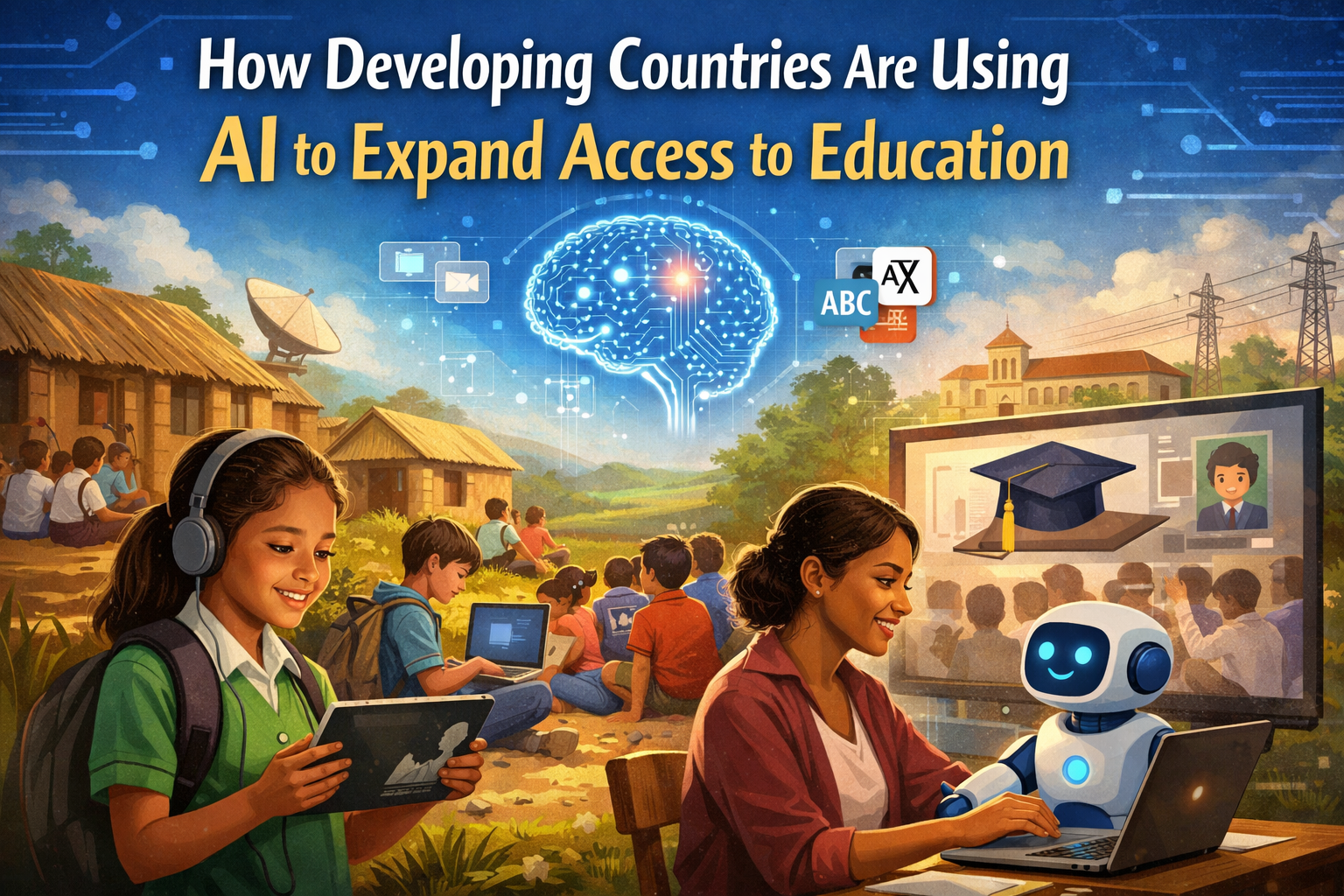
As we all know, education is a mix of hope and struggle in many progressive countries, but students often face problems. Students have to share their books sometimes, classrooms are more crowded than their capacity, and teachers? They put all their efforts into teaching students with limited resources. And after sorting these things, they also have to face the problem of slow internet, sudden power cuts, and expensive education. All these things make every teacher and student frustrated.
But there is also a ray of hope, and in education, that is AI. It helps students to cope with this chaos. Artificial Intelligence is a practical partner for students, not a replacement. It provides tools that make learning a little easier for students and teachers.
In this guide, we will look at how developing countries are using AI to expand access to education.
Education Beyond Physical Classrooms
In many undeveloped areas, access to education depends on geography. People who live near reputable schools are super lucky. If you don’t live near a school, then you may have to face a tough situation. But now, Tools that are powered by AI offer online learning platforms, which help students in accessing education easily.
Many students from rural areas are now able to attend virtual classes, watch recorded lectures, and practice lessons from their homes. These AI systems can detect how fast a student can learn, which helps students learning at their own speed. It is much better than struggling to reach the institute. These types of tools or platforms are perfect for countries that are currently developing.
Learning in Your Own Language (Finally)
Many international students face problems in understanding the language of a new country. In many countries, educational institutes teach students in English or the national language. And it is very difficult for some students to understand any other language.
But AI translation has now solved this issue. There are many speech tools and translators available that help students translate their whole lectures into their local language. Some platforms also text into audios or audios into text. Which genuinely help students in understanding what their teacher is saying in lectures. This technology lets the students learn without feeling stressed or confused.
Students, Meet Your Study Partner
Many students do not have access to reading rooms, personal instructors, or study help. This is where they can take help from AI-powered tools. The good thing about AI is that it is accessible all the time, and students can ask questions at any time. They can see the explanation multiple times and ask AI to structure their assignments without any shame. In many countries, people think that asking for help is a sign of weakness, but taking help online remains a secret between AI and students.
Sometimes students struggle with organizing research and understanding complex topics or chapters. But now they prefer to seek help from platforms that work like a literature review writer AI. These tools help students by making topics understandable for them without killing their own thinking skills.
When Teachers Need Backup Too
Professors in emerging nations work very diligently, and they do everything. From preparing lessons and checking papers to handling classrooms and lectures, they put in all the effort to provide the best quality education. Still, they motivate students and teach them how they can avoid burnout and stress.
You can take help from AI tools for repeated tasks, checking quizzes, writing outlines for assignments, and tracking your progress. This will help teachers save a lot of their time and effort. These AI tools can’t replace teachers, but they will surely help them a lot.
Higher Education Isn’t Just for the Privileged Anymore
In many emerging countries, getting a university-level education is still out of reach for numerous students. Because universities often have limited seats, high tuition fees, and professors who don’t guide students properly.
AI is the only option that can help students with everything. Students are now finding ways to study, like online degree programs or assistance tools. Many online platforms provide support that is the same as that of elite institutions.
Many undergraduate students now prefer to take help from online platforms that have different types of writers, assignment writers, thesis writers, or dissertation writer. These expert writers help students with the structure of their assignments, improve the quality of their content, and organize data. Students take help not because they are lazy, but because they are smart enough to make the right decision.
To Sum It All: Is AI the Hero of the Story?
AI is not something that helps emerging countries to fix broken systems or save them. It supports students and teachers like a side character that helps the hero in movies. It provides you exactly what you want, and then steps back.
If you are a teacher or a student, then you just have to use it thoughtfully. AI will help you with many things without replacing your efforts. It will help you in learning, teaching, making schedules or outlines, checking papers, and many other things. It gives students many chances to learn that they actually deserve.
Numerous students think that education depends on luck, but no, it actually depends on effort and a smarter mind that knows how to find good opportunities.


Introduction
Language has always been a living system. New words emerge, old expressions evolve, and certain terms slowly develop layers of meaning through use in different contexts. One such intriguing word is kompama. At first glance, it may appear unfamiliar, yet it has gradually begun appearing in discussions related to creativity, technology, culture, and philosophy.
The fascination surrounding kompama comes from its flexibility. Unlike many established concepts with rigid definitions, kompama exists in a state of exploration. Writers, thinkers, and innovators have adopted the word in various ways, each interpretation highlighting a slightly different dimension of its meaning.
Some describe kompama as a mindset focused on exploration and adaptive thinking. Others use it to describe a framework for organizing ideas, systems, or communities. In linguistic contexts, the word also traces back to roots associated with sensing, touching, or perceiving. This blend of interpretations makes kompama a rare example of a concept that bridges language, philosophy, and modern innovation.
Understanding kompama requires looking beyond a single explanation. Instead, it involves exploring its linguistic origins, its emerging conceptual interpretations, and the ways people are beginning to apply it in real-world settings.
What Is kompama
Kompama is an evolving concept that represents exploration, adaptive thinking, and structured creativity. Rather than being a single product or defined theory, kompama functions as a flexible idea used to describe systems or mindsets that emphasize sensing, learning, and adjusting in response to changing conditions.
Will You Check This Article: Leonaarei: Unlocking a New Philosophy of Creative Innovation
The linguistic roots of kompama can be traced to an Estonian verb meaning “to touch” or “to feel,” which reflects the idea of understanding something through interaction and observation. This original meaning has influenced how the term is interpreted in modern discussions. Instead of suggesting rigid control, kompama implies awareness, experimentation, and responsiveness.
In contemporary usage, kompama is sometimes described as a conceptual framework for managing information, collaboration, or decision-making. The core idea is that systems work best when they remain flexible enough to adapt while still maintaining an underlying structure.
Because the term is still developing, its meaning continues to expand. Some communities interpret kompama as a philosophy of work and creativity, while others view it as a strategic method for organizing knowledge or building collaborative environments.
This openness is precisely what makes kompama interesting. It is not a closed definition but a concept still being shaped by the people who use it.
The Linguistic Origins of kompama
The roots of kompama offer valuable insight into how the concept evolved. Linguistically, the term originates from the Estonian language, where kompama means “to touch,” “to feel,” or “to sense.”
These meanings are more significant than they might initially appear. Touch and sensing represent one of the most fundamental ways humans understand the world. Long before written language, humans relied on physical interaction with their surroundings to learn and survive.
When the word kompama entered broader discussion, this sensory implication carried forward. Instead of representing rigid knowledge, the term suggests exploration and discovery through experience.
This connection between language and perception is part of why kompama resonates with many writers and thinkers. It reflects a natural process of learning: observing, testing, adjusting, and gradually building understanding.
The linguistic background therefore provides a foundation for how kompama is interpreted today—as a concept that values curiosity and interaction over rigid certainty.
The Evolution of kompama as a Modern Concept
As the word began appearing in modern discussions, its meaning gradually expanded beyond its original linguistic roots. Writers and researchers started using kompama as a metaphor for systems that learn and adapt over time.
In emerging discussions, kompama is often described as an approach to navigating complex environments. Instead of assuming complete knowledge from the beginning, the kompama approach encourages experimentation and iterative learning.
This perspective reflects a broader shift in modern thinking. Many industries and creative fields now recognize that progress rarely happens in a straight line. Instead, it emerges through cycles of testing ideas, evaluating results, and refining strategies.
In this context, kompama represents the philosophy of gradual discovery. It values observation, reflection, and adaptability rather than rigid adherence to predetermined outcomes.
This evolution has allowed kompama to move beyond a simple linguistic expression and become a broader conceptual framework.
Kompama as a Philosophy of Exploration
One of the most compelling interpretations of kompama is as a philosophy of exploration. Rather than demanding immediate certainty, the kompama mindset encourages individuals and organizations to learn through experimentation.
This approach recognizes that complex challenges rarely have simple answers. Instead of forcing quick conclusions, kompama encourages careful observation and continuous adjustment.
Within creative communities, the kompama philosophy often appears in discussions about innovation. Artists, designers, and writers frequently describe their creative process as exploratory. They experiment with ideas, discard what does not work, and gradually refine their vision.
Kompama captures this process perfectly. It frames exploration not as a sign of uncertainty but as a necessary stage of discovery.
The philosophy also reflects a deeper cultural shift toward adaptability. In a rapidly changing world, the ability to observe and respond effectively often proves more valuable than rigid planning.
Kompama in Knowledge Organization
Another important interpretation of kompama focuses on structured organization. Some discussions describe kompama as a framework for managing information and improving clarity within complex systems.
In this sense, kompama emphasizes logical structure while still allowing flexibility. Systems built with a kompama approach prioritize clear organization, accessible information, and adaptive workflows.
This perspective is particularly relevant in environments where large amounts of knowledge must be managed. When information becomes overwhelming, structured frameworks help maintain order and accessibility.
The kompama framework therefore acts as a balancing mechanism. It ensures that systems remain organized while still capable of evolving as new insights emerge.
This combination of structure and flexibility is one of the defining characteristics of kompama as a modern concept.
Creative Thinking and the Kompama Mindset
Creativity thrives in environments where ideas are allowed to develop gradually. The kompama mindset supports this process by encouraging experimentation and revision.
Instead of expecting perfection at the first attempt, kompama recognizes that creative breakthroughs often emerge from repeated exploration. Writers may revise drafts multiple times. Designers test different visual approaches. Researchers refine hypotheses through ongoing study.
This iterative process mirrors the essence of kompama. Each step builds upon previous insights, gradually shaping a clearer understanding of the final outcome.
Another important aspect of the kompama mindset is intellectual humility. It acknowledges that initial assumptions may not always be correct. By remaining open to adjustment, individuals can refine their ideas more effectively.
In this way, kompama promotes a culture of curiosity and continuous learning.
Kompama and Collaborative Communities
Beyond individual creativity, kompama also has implications for collaboration. Many modern projects involve teams with diverse skills and perspectives. Coordinating these different viewpoints requires a flexible yet structured approach.
The kompama philosophy supports collaboration by encouraging open dialogue and shared exploration. Instead of imposing rigid hierarchies of ideas, teams can experiment with different approaches and collectively evaluate their effectiveness.
This process fosters stronger communication and more innovative outcomes. When participants feel comfortable sharing ideas without immediate judgment, creativity expands.
Kompama therefore represents more than a theoretical concept. It becomes a practical method for guiding collaborative thinking.
The Future Potential of kompama
Because kompama is still evolving, its future remains open to interpretation. However, several trends suggest how the concept may develop.
First, the idea of adaptive systems continues to gain importance across many fields. As complexity increases, frameworks that support flexibility and learning become increasingly valuable.
Second, the growing emphasis on interdisciplinary thinking aligns closely with the kompama philosophy. Modern challenges often require combining insights from multiple disciplines, which naturally involves exploration and adjustment.
Third, the cultural shift toward lifelong learning reinforces the relevance of kompama. In a world where knowledge constantly evolves, the ability to sense changes and adapt accordingly becomes a critical skill.
These trends suggest that kompama may continue gaining attention as a concept that reflects the realities of modern problem-solving.
Conclusion
Kompama is a fascinating example of how language and ideas evolve together. What began as a simple linguistic expression associated with sensing or touching has gradually developed into a broader concept representing exploration, adaptability, and structured creativity.
The strength of kompama lies in its openness. Rather than forcing a rigid definition, the concept invites interpretation and experimentation. It reflects a way of thinking that values learning through interaction with the world.
In creative fields, kompama encourages experimentation and gradual refinement of ideas. In collaborative environments, it supports open dialogue and shared discovery. In knowledge systems, it promotes structured organization while maintaining flexibility.
Perhaps the most important insight offered by kompama is this: understanding rarely emerges instantly. Instead, it grows through observation, reflection, and thoughtful adjustment.
As the concept continues to evolve, kompama may become an increasingly valuable lens through which people approach creativity, collaboration, and problem-solving.
FAQs
1. What does kompama mean?
Kompama is an evolving concept often associated with exploration, adaptive thinking, and structured creativity. Linguistically, it originates from an Estonian verb meaning “to touch” or “to feel.”
2. Is kompama a specific technology or platform?
No. Kompama is not universally recognized as a single product or system. It is more accurately described as a developing concept used in different contexts.
3. Why does kompama have multiple meanings?
The term is still in a formative stage, which allows different communities to interpret it in ways that fit their ideas and needs.
4. How is kompama used in creative work?
In creative fields, kompama represents a mindset that encourages experimentation, iterative improvement, and openness to revising ideas.
5. Why is kompama becoming popular in modern discussions?
Its emphasis on adaptability and exploration aligns with how modern systems, organizations, and creative processes operate in complex environments.
Introduction
In the modern world, new concepts often emerge at the intersection of science, culture, and human curiosity. One such concept that has quietly attracted attention in recent years is dympigal. Although the term may sound unfamiliar at first, discussions around it have appeared in technological, philosophical, and wellness circles, each exploring different interpretations of what it represents.
The fascination surrounding dympigal lies in its layered meaning. Some view it as an advanced analytical system capable of identifying patterns within complex information. Others interpret it as a conceptual framework for understanding hidden forces that shape decisions, behavior, and future possibilities. Regardless of the perspective, the idea behind dympigal reflects a broader human desire: the need to understand uncertainty and transform scattered information into meaningful insight.
As knowledge systems evolve, concepts like dympigal highlight how humans are constantly searching for tools that bridge logic and intuition. Rather than existing in a single discipline, the idea has gradually become a multidisciplinary concept that combines analytical thinking, human interpretation, and adaptive learning.
Understanding dympigal requires exploring its origins, its underlying mechanisms, and the ways it influences modern thinking. When examined carefully, the concept reveals a fascinating attempt to merge data-driven intelligence with the deeper patterns that govern human experiences.
What Is Dympigal
Dympigal is generally described as an advanced analytical concept or system designed to interpret complex information and generate meaningful insights from it. At its core, dympigal focuses on recognizing patterns, identifying connections, and transforming raw information into actionable understanding.
Will You Check This Article: Dfcbktr: Decoding a Mysterious Framework Shaping Modern Innovation
In many discussions, dympigal is portrayed as a framework that blends intelligent algorithms, human intuition, and large datasets to analyze trends or predict possible outcomes. The strength of the approach lies in its adaptive nature. As new information becomes available, the system continuously refines its interpretations, allowing insights to evolve over time.
Unlike traditional analytical models that depend strictly on fixed calculations, dympigal emphasizes learning and adaptation. This flexibility allows it to operate effectively even in situations where conditions are constantly changing.
Beyond technical definitions, dympigal is also described in philosophical contexts as a symbolic representation of hidden knowledge or emerging insight. In this interpretation, it represents the process of discovering meaning within complexity.
Whether viewed as a technological system or a conceptual philosophy, dympigal ultimately revolves around one central idea: the transformation of uncertainty into understanding.
The Origins and Evolution of Dympigal
The origins of dympigal are difficult to trace to a single source. Instead, the idea appears to have evolved gradually from multiple intellectual traditions. Early references often connect the concept with the human effort to interpret patterns in nature, economics, and human behavior.
Historically, civilizations relied on observation and intuition to predict outcomes. Ancient scholars studied weather patterns, agricultural cycles, and celestial movements in an attempt to anticipate the future. While these practices were not called dympigal at the time, the underlying principle was similar: searching for hidden patterns within complex systems.
As modern computing technologies emerged, pattern recognition began shifting from human observation to computational analysis. Large datasets could now be examined with far greater speed and accuracy than before. Over time, this capability led to the development of analytical frameworks capable of discovering relationships that were previously invisible.
The idea of dympigal emerged from this technological environment. It represented a new approach where human reasoning and intelligent analysis worked together rather than independently.
In recent discussions, dympigal has also been linked with cultural symbolism and philosophical interpretations of hidden knowledge. Some thinkers describe it as a metaphor for the unseen forces that guide transformation and balance in complex systems.
This blend of scientific and philosophical roots has allowed dympigal to evolve into a concept that is both analytical and reflective.
How Dympigal Works
The functioning of dympigal is typically explained through the process of pattern analysis and adaptive learning. In practical terms, it begins with the collection of large volumes of information drawn from multiple sources. These datasets may include behavioral trends, economic indicators, environmental data, or other measurable variables.
Once the information is gathered, analytical algorithms begin examining it for correlations and patterns. The system searches for relationships that may not be immediately visible through traditional analysis. By identifying recurring structures within the data, dympigal creates predictive insights that help explain possible future developments.
One of the most important aspects of dympigal is its ability to evolve as new information becomes available. Instead of relying on static calculations, it continuously updates its internal models to reflect changing circumstances.
This learning process allows the system to refine its predictions over time. The more information it processes, the more precise its insights become.
Another distinctive characteristic of dympigal is the integration of human interpretation. While algorithms may reveal patterns, human judgment remains essential for understanding the broader meaning behind those patterns. The combination of analytical processing and human reasoning gives dympigal its unique strength.
The Philosophical Meaning Behind Dympigal
Beyond its technical description, dympigal has also been interpreted as a philosophical symbol representing balance, transformation, and hidden knowledge. In this sense, the concept reflects humanity’s attempt to understand the unseen forces that shape reality.
Philosophers have suggested that dympigal embodies the tension between certainty and uncertainty. Knowledge rarely exists in a perfectly clear form. Instead, it often emerges gradually through exploration and reflection. The idea of dympigal captures this process by emphasizing discovery rather than absolute certainty.
Some interpretations compare the concept with ancient symbolic traditions where opposing forces coexist in balance. Light and shadow, logic and intuition, order and chaos all represent complementary aspects of a larger system.
From a psychological perspective, dympigal can also be viewed as a metaphor for the human mind’s ability to integrate conscious reasoning with unconscious insight. The mind constantly processes information below the level of awareness, gradually revealing patterns that shape decision-making.
In this way, dympigal becomes more than an analytical tool. It becomes a representation of how understanding itself evolves.
Practical Applications of Dympigal
Although dympigal is often discussed conceptually, its principles have practical applications across several fields. Organizations use pattern recognition systems inspired by similar ideas to interpret complex datasets and guide strategic decisions.
In economic forecasting, analytical frameworks based on dympigal concepts help researchers identify early signals of market shifts. By examining historical data alongside emerging trends, analysts can develop models that anticipate potential changes.
Healthcare research also benefits from similar analytical approaches. By analyzing patterns within medical records and biological data, researchers can uncover relationships that contribute to improved diagnosis and treatment strategies.
Educational institutions have begun exploring these analytical systems as well. By examining patterns in learning behavior, educators can gain insights into how students absorb information and adapt teaching methods accordingly.
The flexibility of dympigal allows it to operate across diverse environments where complexity and uncertainty are common.
The Cultural Influence of Dympigal
Culturally, dympigal has become a symbol of humanity’s evolving relationship with knowledge. In literature and artistic expression, the concept often appears as a representation of hidden insight or transformative understanding.
Artists sometimes portray dympigal as a mysterious force guiding discovery and innovation. In this narrative, individuals encounter moments of sudden clarity where complex ideas suddenly become understandable.
Writers exploring philosophical themes have used dympigal as a metaphor for intellectual awakening. The concept illustrates the moment when scattered observations begin forming a coherent picture.
This cultural interpretation highlights the deeper human fascination with knowledge itself. People have always sought ways to uncover the invisible patterns shaping their world.
By embodying this quest for understanding, dympigal has become both an analytical concept and a cultural symbol.
Challenges and Misinterpretations of Dympigal
Despite its intriguing potential, the concept of dympigal is sometimes misunderstood. Because the term has appeared in different contexts, interpretations can vary widely.
Some discussions exaggerate the predictive power of systems associated with dympigal, suggesting they can forecast events with absolute certainty. In reality, no analytical model can eliminate uncertainty completely. Even the most advanced systems operate within probabilities rather than guarantees.
Another challenge lies in the risk of overreliance on automated analysis. While pattern recognition can reveal important insights, human reasoning remains essential for interpreting results responsibly.
Ethical considerations also emerge when powerful analytical systems influence important decisions. Transparency and accountability become crucial factors in ensuring these systems are used responsibly.
Understanding these limitations helps maintain a balanced perspective on what dympigal can realistically achieve.
The Future Potential of Dympigal
As analytical technologies continue advancing, the principles associated with dympigal are likely to play an increasingly significant role in shaping how information is interpreted.
Future systems may combine multiple forms of intelligence, including pattern recognition, behavioral modeling, and contextual analysis. These systems could assist researchers, policymakers, and organizations in navigating complex challenges.
At the same time, the philosophical dimension of dympigal will likely remain relevant. Technology may improve analytical capabilities, but human interpretation will always remain essential for understanding meaning.
The future of dympigal may therefore lie in the collaboration between human insight and intelligent analytical systems. Rather than replacing human thinking, it enhances our ability to perceive patterns that were once invisible.
Conclusion
Dympigal represents a fascinating intersection of analytical innovation and philosophical reflection. While the concept may appear mysterious at first glance, its core purpose is surprisingly simple: transforming complexity into understanding.
Whether viewed as a predictive framework, a pattern-recognition system, or a symbolic representation of hidden knowledge, dympigal reflects humanity’s ongoing effort to make sense of an increasingly complex world.
Its evolution demonstrates how knowledge itself is constantly expanding. New tools allow people to analyze vast amounts of information, yet the ultimate goal remains the same as it has always been: discovering meaning within uncertainty.
By combining analytical reasoning with human intuition, dympigal illustrates the future of intelligent understanding. It reminds us that insight does not emerge from data alone but from the thoughtful interpretation of patterns that shape our reality.
FAQs
What does dympigal mean?
Dympigal generally refers to a conceptual or analytical framework designed to identify patterns in complex information and generate meaningful insights from large datasets.
Is dympigal a technology or a philosophical idea?
Dympigal can be interpreted both ways. In technological discussions it refers to advanced analytical systems, while in philosophical contexts it symbolizes hidden knowledge and transformation.
How does dympigal analyze information?
Dympigal examines large datasets, identifies patterns and correlations, and refines its interpretations as new information becomes available.
Why is dympigal considered important today?
Because modern systems generate enormous amounts of information, frameworks like dympigal help transform complex data into understandable insights that support better decision-making.
Can dympigal predict the future accurately?
Dympigal can identify trends and probabilities based on patterns in information, but like any analytical system it cannot guarantee perfectly accurate predictions.
Introduction
New terms appear constantly in the evolving world of technology, innovation, and online culture. Some are carefully designed frameworks, while others begin as mysterious strings of characters that gradually gain meaning through use. One such intriguing term is dfcbktr. At first glance, it appears cryptic and unfamiliar, yet discussions around dfcbktr have steadily grown in technology circles, development communities, and experimental innovation spaces.
The fascination surrounding dfcbktr comes from its unusual nature. Unlike traditional technical terms that emerge from clearly defined systems, dfcbktr represents a concept that blends structured technology thinking with modern collaboration models. Some researchers view it as a framework designed to organize knowledge and streamline information flow within complex environments. Others see it as a flexible symbol for emerging digital experimentation and technological creativity.
What makes dfcbktr particularly interesting is that it reflects a broader trend in modern technology culture: the creation of adaptable frameworks that can evolve alongside rapidly changing systems. Instead of remaining locked in a single definition, dfcbktr continues to develop through interpretation, experimentation, and real-world implementation. Understanding this concept requires looking beyond the letters themselves and examining the technological philosophy behind them.
What Is dfcbktr
The term dfcbktr is commonly interpreted as a structured framework designed to improve how information, processes, and knowledge move within modern technological environments. Some interpretations describe dfcbktr as an acronym representing a system that organizes data frameworks for knowledge transfer and retrieval across collaborative platforms.
Will You Check This Article: Bardid: The Rising Framework for Secure Identity Systems
At its core, dfcbktr focuses on one central challenge faced by modern organizations: how to ensure that valuable information flows efficiently between people, systems, and departments. As companies grow more complex and distributed, knowledge can easily become fragmented or lost within large infrastructures. The dfcbktr model attempts to address this issue by introducing a structured approach to managing information flow and collaboration.
Another important dimension of dfcbktr is flexibility. Unlike rigid systems that operate within fixed rules, dfcbktr frameworks often adapt to the needs of the environment in which they operate. Developers, analysts, and innovation teams can customize dfcbktr structures according to their own operational requirements. This adaptability allows the concept to function in diverse settings, from software development teams to large organizational data systems.
The key principle behind dfcbktr is that knowledge should move seamlessly between systems and individuals. Instead of information remaining isolated within separate tools or departments, dfcbktr encourages structured communication and accessible knowledge sharing across an entire operational ecosystem.
The Origins and Conceptual Development of dfcbktr
The emergence of dfcbktr can be traced to the growing complexity of modern technological systems. As organizations began relying on cloud infrastructure, collaborative platforms, and distributed teams, managing information became significantly more challenging.
Early technology innovators recognized that traditional data structures often failed to keep pace with evolving workflows. Teams needed systems that could not only store information but also enable dynamic retrieval, sharing, and reinterpretation of knowledge. The idea behind dfcbktr emerged as a response to these challenges.
Rather than being created by a single organization, the concept appears to have developed gradually through experimentation within technology communities. Developers began exploring frameworks capable of supporting both structured information systems and collaborative innovation. Over time, dfcbktr became associated with this broader philosophy of intelligent knowledge organization.
One interesting aspect of the term is that its cryptic appearance reflects the experimental culture from which it emerged. In many technical communities, unusual letter combinations are often used as internal project identifiers or prototype framework names. As these projects evolve and gain attention, the identifiers themselves sometimes become permanent labels.
Today, dfcbktr represents more than a simple acronym. It symbolizes a shift toward more fluid knowledge structures designed to operate within constantly changing technological environments.
The Structural Principles Behind dfcbktr
Understanding dfcbktr requires examining the principles that guide its structure. At its foundation, the framework revolves around the idea that information should be both accessible and meaningful. Raw data alone has limited value unless it can be interpreted and applied effectively.
Within a dfcbktr system, information typically moves through layered structures that organize data, contextual meaning, and collaborative insights. These layers allow individuals working within the framework to retrieve relevant knowledge quickly while still preserving the deeper context behind that information.
Another principle associated with dfcbktr is modular organization. Instead of building massive centralized systems that attempt to manage every aspect of knowledge, dfcbktr frameworks often rely on smaller interconnected components. Each component performs a specific function, such as storing project documentation, managing development insights, or organizing collaborative discussions.
This modular approach makes dfcbktr systems highly scalable. Organizations can expand their information frameworks gradually without disrupting existing operations. As new departments or projects emerge, additional modules can be integrated into the framework.
The result is a flexible knowledge infrastructure that grows alongside the organization using it.
Real-World Applications of dfcbktr
Although dfcbktr remains an evolving concept, its principles have already found practical applications across several industries. One of the most common areas where dfcbktr frameworks appear is software development.
Development teams often deal with enormous volumes of information, including code repositories, documentation, testing results, and collaborative discussions. Without an organized structure, valuable insights can easily become scattered across multiple platforms. By applying dfcbktr principles, teams create integrated systems that centralize knowledge while still allowing flexible access for different roles within the project.
Another important application appears in large organizations that depend on complex knowledge networks. Research departments, engineering teams, and strategic planning groups frequently require quick access to specialized information. A dfcbktr-inspired structure helps ensure that knowledge remains searchable, organized, and connected across the entire organization.
Start-ups also find value in dfcbktr approaches because they allow rapid adaptation. Young companies often change direction as they refine their products and strategies. Traditional rigid information systems can slow down this process, whereas dfcbktr frameworks support continuous experimentation and restructuring.
Beyond corporate environments, the concept has also attracted attention in educational technology and collaborative research communities where structured knowledge sharing plays a crucial role.
The Strategic Importance of dfcbktr in Modern Technology
The significance of dfcbktr extends beyond its technical structure. It reflects a deeper shift in how modern organizations think about knowledge itself. In earlier technological eras, information was often treated as static content stored within databases or documents.
Today, knowledge behaves more like a living ecosystem. Ideas evolve through collaboration, reinterpretation, and continuous refinement. The dfcbktr philosophy acknowledges this reality by emphasizing dynamic knowledge structures rather than static archives.
Organizations that adopt dfcbktr-style frameworks often gain a strategic advantage because their teams can access insights more quickly and respond to challenges with greater agility. Instead of spending time searching for scattered information, employees can focus on analysis, innovation, and decision-making.
Another strategic benefit lies in cross-department collaboration. When knowledge systems are fragmented, departments tend to operate in isolation. A well-implemented dfcbktr structure connects these departments through shared knowledge pathways, encouraging cooperation and collective problem-solving.
In rapidly evolving industries where speed and adaptability determine success, such collaborative efficiency can make a substantial difference.
Challenges and Limitations of dfcbktr
Despite its promising advantages, dfcbktr is not without challenges. Implementing any structured knowledge framework requires careful planning and cultural adaptation. Employees accustomed to traditional systems may initially resist adopting new organizational structures.
Another challenge arises from the complexity of large information ecosystems. When a dfcbktr framework expands across multiple departments or platforms, maintaining consistent data structures becomes essential. Without proper governance, even flexible systems can become disorganized over time.
Security considerations also play a role. Knowledge frameworks that encourage open access must still protect sensitive information and maintain clear permission structures. Organizations implementing dfcbktr systems must carefully balance accessibility with confidentiality.
Furthermore, the concept itself continues to evolve. Because dfcbktr is still relatively new and interpreted differently across industries, there is no universal implementation model. Each organization must experiment and refine its own version of the framework.
While these challenges exist, they also highlight the experimental nature of dfcbktr. The framework continues to mature as organizations learn from real-world implementations.
The Future Evolution of dfcbktr
Looking ahead, dfcbktr is likely to evolve alongside emerging technological trends. As artificial intelligence, collaborative platforms, and distributed teams become more common, the demand for structured knowledge frameworks will only increase.
Future versions of dfcbktr may integrate advanced analytical tools capable of identifying patterns within knowledge networks. These systems could automatically connect related information, helping users discover insights that might otherwise remain hidden.
Another potential development involves decentralized collaboration models. As organizations increasingly operate across multiple geographic regions, knowledge frameworks must support asynchronous communication and global teamwork. The flexible architecture of dfcbktr makes it well suited for such environments.
Educational institutions and research communities may also adopt dfcbktr principles to manage complex bodies of knowledge. Large research networks often struggle with fragmented information systems, and structured frameworks like dfcbktr could significantly improve knowledge sharing among researchers.
Ultimately, the future of dfcbktr will depend on how innovators continue to experiment with the concept. Like many emerging frameworks, its evolution will be shaped by real-world needs and creative technological exploration.
Conclusion
The term dfcbktr may initially appear as nothing more than a puzzling combination of letters, yet behind it lies an emerging philosophy about how knowledge should move through modern systems. Rather than focusing solely on storing information, dfcbktr emphasizes structured collaboration, adaptable frameworks, and accessible knowledge networks.
As organizations grow more complex and interconnected, the ability to manage information effectively becomes a defining factor of success. Frameworks inspired by dfcbktr address this challenge by creating environments where insights can flow freely while still maintaining structure and clarity.
Although the concept continues to evolve and lacks a single universal definition, its underlying principles already reflect an important shift in technological thinking. Knowledge is no longer static. It is dynamic, collaborative, and constantly expanding.
Dfcbktr represents a step toward building systems capable of supporting that new reality.
FAQs
1. What does dfcbktr stand for?
Dfcbktr is sometimes interpreted as a framework related to structured knowledge transfer and information retrieval systems. Different communities may interpret the acronym differently, but it generally refers to methods of organizing and sharing complex data environments.
2. Is dfcbktr a technology or a concept?
Dfcbktr is best understood as a conceptual framework rather than a single piece of technology. It represents a structured approach to managing information and collaboration within modern technological environments.
3. Where is dfcbktr used in real life?
Dfcbktr principles can appear in software development teams, corporate knowledge systems, research collaboration networks, and innovative start-up environments where efficient information flow is essential.
4. Why is dfcbktr gaining attention in technology discussions?
The growing complexity of modern information systems has increased the need for flexible frameworks that allow teams to share and retrieve knowledge efficiently. Dfcbktr addresses this challenge by emphasizing structured collaboration.
5. Can small organizations benefit from dfcbktr?
Yes. Smaller organizations often benefit from dfcbktr because its flexible structure allows them to organize knowledge efficiently while still adapting quickly as the company grows.

Protect the Surface, Promote the Brand: The Subtle Power of Totally Branded Coasters

Celebrity Skincare Hype vs. Reality: What the Reviews Reveal (and How Brands Use Email to Retain)

A Bright Future with Timur Turlov and Freedom Holding Corp

Mark McCann Net Worth 2025: Supercars And Millions

Elizabeth Huberdeau: Life Beyond Being John Cena’s First Wife

Is Elizabeth Rizzini Still Married? Inside Her Private Life in 2025
-

 Business1 week ago
North American Freight and Courier Strategies
-

 Blogs6 days ago
Day-To-Night Outfit Transformations
-

 Business1 week ago
Top 3 Features That Make Coinremitter a Leading Cryptocurrency Payment Gateway
-

 Health1 week ago
Best Semaglutide Provider: 7 Top Medical Weight Loss Services Compared
-

 Blogs6 days ago
Oronsuuts and the Transformation of Urban Housing Culture
-
 Tech5 days ago
Nionenad Concept: Innovation, Identity, and Emerging Culture
-

 Tech6 days ago
Grospal Platform Revolutionizing Modern Business Collaboration
-

 Fashion1 week ago
Fedsolife Brand Story: Affordable Style and Modern Accessories